
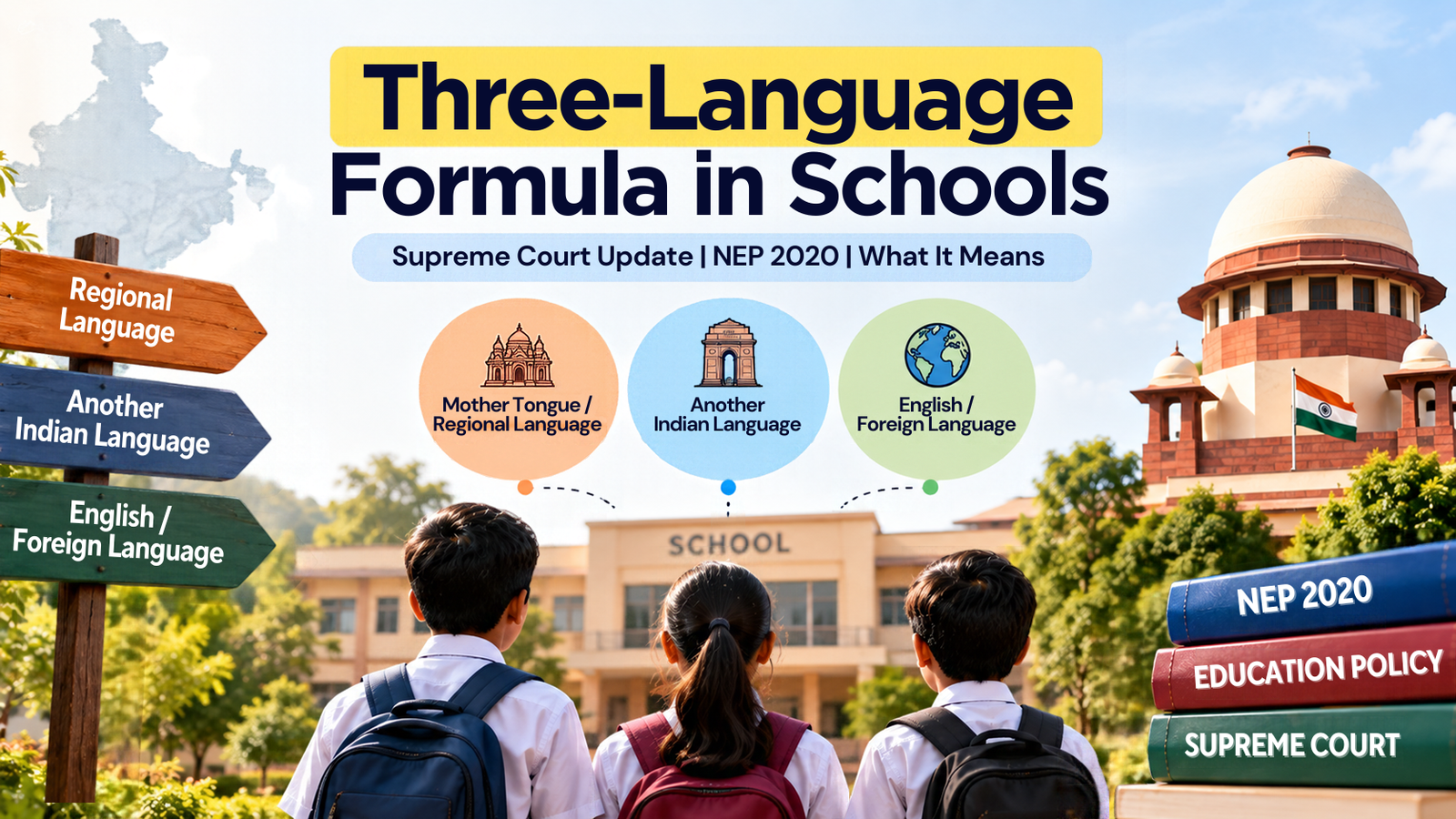
India’s three-language formula has returned to the national education debate after the Central Board of Secondary Education (CBSE) introduced new language requirements and the Supreme Court examined concerns about their implementation. The discussion involves more than learning an additional language: it raises questions about regional identity, students’ academic workload, teacher availability, and the role of English and Indian languages in schools.
The National Education Policy (NEP) 2020 supports multilingual education while stating that no language should be imposed on any state. However, applying this principle across India’s different school systems has proved challenging.
The latest legal position is important: the Supreme Court did not issue a final nationwide order making the formula compulsory from January 1, 2027. On September 28, 2026, it directed that students currently in Class 6 under CBSE receive the same exemption as students in Class 7. The broader challenge remains pending. (See the Supreme Court’s September 28 order.)
What Is the Three-Language Formula?
The three-language formula is an educational framework under which students learn three languages during their school years. Its purpose is to encourage multilingual ability, improve communication, and help students understand different linguistic and cultural communities.
The idea predates NEP 2020. Earlier national education policies also promoted a three-language approach. NEP 2020 retains the framework but emphasises greater flexibility in choosing languages.
Under paragraph 4.13 of the National Education Policy 2020, students’ language choices should reflect the preferences of states, regions, and students, with at least two of the three languages being native to India.
This does not mean every school must teach the same three languages. The languages offered depend on the applicable curriculum, educational board, and implementation rules.
What Does NEP 2020 Say About Language Learning?
NEP 2020 places considerable emphasis on multilingual education and the importance of students learning through languages they understand.
Its language-related objectives include:
- Encouraging proficiency in multiple languages.
- Supporting the preservation and development of Indian languages.
- Promoting cultural understanding and national unity.
- Providing flexibility in language selection.
- Supporting the use of the home, mother, or regional language as the medium of instruction, wherever possible, at least until Grade 5 and preferably beyond.
The policy explicitly states that no language will be imposed on any state. It also allows students to change one or more of their chosen languages in Grade 6 or 7, subject to the prescribed proficiency requirements by the end of secondary school.
These principles are intended to balance national educational goals with linguistic diversity. The ongoing debate concerns how effectively the implementation arrangements protect that flexibility.
What Has the Supreme Court Said About Implementation in 2026?
The recent proceedings concern challenges to CBSE’s implementation of the three-language scheme, including the introduction of a compulsory third language in Class 6.
September 17, 2026: The court suggested a later rollout
During the hearing on September 17, the Supreme Court asked CBSE to reconsider whether mandatory implementation for Class 6 should be deferred to 2027. The discussion followed concerns about the time available to students, families, and schools to adjust.
The court also discussed whether students who wished to study a third language during the current academic year should be permitted to do so voluntarily. The issue was not finally decided at that hearing.
September 28, 2026: Exemption for the current Class 6 batch
In its interim order dated September 28, the court directed that students currently in Class 6 be granted the same exemption as those in Class 7.
The written order also provided for further pleadings and listed the connected matters for consideration on November 19, 2026. It did not decide the entire constitutional and policy dispute.
During the hearing, the court discussed implementation from April 2027 to give students more time to adjust. This should not be confused with a final order specifying January 1, 2027, as a universal commencement date.
The distinction matters because the proceedings concern CBSE’s rules and the particular student batches affected by them. They should not be described as a final nationwide mandate applying identically to every state board.
For updates, readers can consult the official CBSE Academic website and the relevant court orders.
How Does the Three-Language Scheme Work Under CBSE?
CBSE issued Circular No. Acad-17/2026 on April 9, 2026, directing affiliated schools to introduce the third language, referred to as R3, in Class 6 under the 2026–27 Scheme of Studies.
Its more detailed guidelines followed in Circular No. Acad-49/2026, dated July 10, 2026.
The CBSE framework uses three labels:
- R1: The first language.
- R2: The second language.
- R3: The third language.
Under the guidelines, two of the three languages must be Indian languages, described in the circular as Bharatiya Bhashas. Examples include Hindi, Sanskrit, Tamil, Telugu, Kannada, Malayalam, Marathi, Bengali, Punjabi, Gujarati, and Odia.
CBSE classifies English, French, German, Arabic, and Spanish as non-native languages in these guidelines. A non-native language may be selected as R3 when the other two chosen languages are Indian languages. Therefore, English is not automatically an eligible substitute for either of the two Indian languages under the circular’s framework.
The circular also provides transitional arrangements for different classes and exemptions for specified groups. Children with special needs receive applicable relaxations under disability-related requirements, while certain provisions apply to schools outside India and foreign students returning to India.
The exact requirements differ by class and academic year. Families should consult the relevant circular rather than assuming that all current students must change their existing language combinations in the same way.
Read the official CBSE three-language guidelines for the detailed rules.
Why Is the Three-Language Formula Controversial?
The main disagreement concerns whether a flexible multilingual policy can be implemented without placing pressure on students or weakening the position of regional languages.
Concerns about Hindi imposition
Tamil Nadu has long followed a two-language approach in its state-board schools, centred on Tamil and English. Political leaders and critics have expressed concern that a three-language requirement could create pressure to learn Hindi, even if the national policy does not formally mandate it.
Maharashtra experienced a separate controversy in 2025 when its government introduced orders involving Hindi as the default third language in primary state-board schools. Following public opposition, the state revoked those orders on June 30, 2025.
That episode illustrates why language policy can provoke strong reactions. It is important, though, to distinguish Maharashtra’s state-board primary-school controversy from the current CBSE guidelines.
Other states also debate how to protect regional-language interests and how many languages children should study. Their policies and political positions are not identical, and opposition to a particular implementation method does not necessarily mean opposition to multilingual education itself.
The question of English
Another issue before the Supreme Court is the treatment of English as a non-native language under CBSE’s framework.
English is widely used in Indian education, administration, and professional life. Critics have questioned whether its classification creates practical difficulties when students already study English alongside a regional language.
CBSE’s current circular expressly places English among its non-native language examples. The legal challenge concerning the policy, including the treatment of English, remains subject to further consideration.
Until the court reaches a final decision on the issues before it, readers should distinguish the existing CBSE guidelines from arguments made by petitioners or observations expressed during hearings.
What Challenges Will Schools and Students Face?
Even when schools support multilingual learning, effective implementation requires planning.
Availability of qualified teachers: Schools must arrange staff who can teach the selected languages. CBSE’s guidelines allow flexible staffing arrangements, including the use of existing teachers with suitable proficiency, retired teachers, inter-school cooperation, and virtual or hybrid teaching.
Textbooks and learning materials: Students need appropriate materials at their learning level. A school that introduces a language without adequate textbooks or teaching resources may struggle to deliver the expected curriculum.
Academic workload: Learning another language requires time for speaking, reading, writing, and assessment. Schools must ensure that the third language does not become an unreasonable additional burden.
Differences between schools: A language taught by several experienced teachers in one school may be difficult to offer in another. Rural schools and smaller institutions may face different logistical challenges from well-resourced urban schools.
Students who move between states: Families may relocate for work or other reasons. Schools need practical arrangements to prevent students from being disadvantaged when their earlier language combination differs from the languages available at their new school.
The purpose of implementation planning should be to make language learning meaningful rather than simply adding another subject to the timetable.
What Should Parents and Students Do Now?
Parents should first identify which school board their child follows. CBSE-affiliated schools, state-board schools, and other educational systems may operate under different rules.
Check the school’s current language choices and ask how R3 will be taught, assessed, and supported. If a student already studies three languages, clarify whether the transitional provisions apply to that class and academic year.
Schools should follow applicable CBSE circulars and any subsequent binding directions from the court. They should also communicate language choices, teaching arrangements, assessment procedures, and available exemptions clearly to families.
For students, the most useful approach is to understand the prescribed requirements and discuss any genuine difficulty with the school. News reports about court hearings should not be treated as a substitute for the final rules applicable to an individual student.
Frequently Asked Questions
Is the three-language formula compulsory in every Indian school?
The national policy promotes the three-language framework, but implementation depends on the applicable board and state arrangements. The current CBSE scheme has specific rules for its affiliated schools; it should not be described as an identical, directly enforced timetable for every school system in India.
Has the Supreme Court ordered implementation from January 1, 2027?
No final nationwide order establishing that date has been identified. In September 2026, the court discussed delaying the Class 6 rollout and granted the current Class 6 batch the same exemption as Class 7. The connected proceedings remain pending.
Does the policy require every student to learn Hindi?
NEP 2020 states that no language will be imposed on any state. CBSE’s current guidelines require at least two of the three languages to be Indian languages, subject to the prescribed rules and transitional provisions. Students and parents should consult the current language options offered by their school.
Can English count as one of the three languages?
CBSE’s July 2026 guidelines classify English as a non-native language. Under those rules, a non-native language can be selected as the third language when the other two are Indian languages. The wider question concerning English’s classification is part of the pending legal challenge.
When will the Supreme Court hear the case again?
The written order dated September 28, 2026, listed the connected matters for consideration on November 19, 2026. The hearing date and subsequent directions should be verified through reliable court reporting or the relevant court records.
Conclusion
The three-language formula seeks to encourage multilingualism and strengthen students’ connections with India’s linguistic diversity. Its success depends on whether schools can provide the necessary teachers, learning materials, and flexibility without imposing an unreasonable burden on children.
NEP 2020 leaves language choices to states, regions, and students within its stated framework, while CBSE has issued more specific implementation rules for its affiliated schools. The Supreme Court’s recent intervention has addressed the transition for the current Class 6 batch, but the wider policy challenge remains unresolved.
For students and parents, the practical priority is to check the rules that apply to their school and class. For policymakers and school administrators, the larger task is to implement multilingual education in a way that respects regional languages, accommodates local realities, and supports students’ learning.
Written by: Nishant Verma
Sources: