
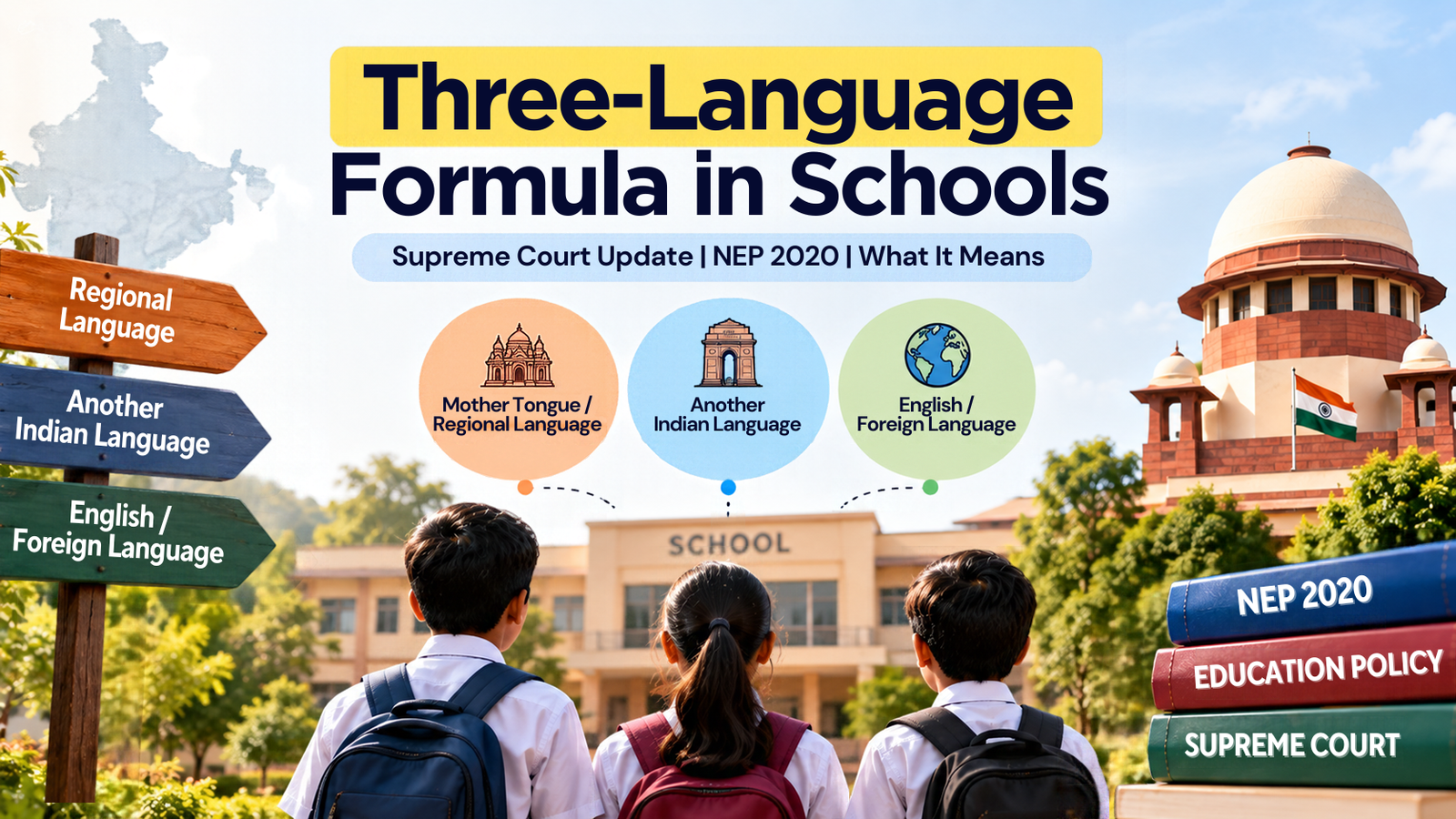
India’s three-language formula has come back into discussion in relation to the new policy brought in by the Central Board of Secondary Education (CBSE) and the questions raised about the implementation of this policy in discussion by the Supreme Court. This is not only about learning new languages, but it involves issues such as regional identity, students’ academic burden, availability of teachers, as well as the importance of English and Indian languages in schools.
The National Education Policy (NEP) 2020 promotes the ideology of multilingual education, adding that it is wrong to test any of the languages covered by this ideology on the state level. However, it appears that implementation of this rule across different school systems in the country has not been effective.
The latest legal position is important: the Supreme Court did not issue a final nationwide order making the formula compulsory from January 1, 2027. On September 28, 2026, it directed that students currently in Class 6 under CBSE receive the same exemption as students in Class 7. The broader challenge remains pending. (See the Supreme Court’s September 28 order.)
What Is the Three-Language Formula?
The three-language formula is a framework for education where students study languages in schools. It aims to support multilingual abilities and enhance communication.
The scheme existed before NEP 2020. The previous national education policy by the Indian government also adopted a similar strategy. However, NEP 2020 brings a great deal of flexibility in relation to the language scheme.
Under paragraph 4.13 of the National Education Policy 2020, students’ language choices should reflect the preferences of states, regions, and students, with at least two of the three languages being native to India.
This does not mean every school must teach the same three languages. The languages offered depend on the applicable curriculum, educational board, and implementation rules.
What Does NEP 2020 Say About Language Learning?
NEP 2020 places considerable emphasis on multilingual education and the importance of students learning through languages they understand.
Its language-related objectives include:
- Encouraging proficiency in multiple languages.
- Supporting the preservation and development of Indian languages.
- Promoting cultural understanding and national unity.
- Providing flexibility in language selection.
- Supporting the use of the home, mother, or regional language as the medium of instruction, wherever possible, at least until Grade 5 and preferably beyond.
The policy explicitly states that no language will be imposed on any state. It also allows students to change one or more of their chosen languages in Grade 6 or 7, subject to the prescribed proficiency requirements by the end of secondary school.
These principles are intended to balance national educational goals with linguistic diversity. The ongoing debate concerns how effectively the implementation arrangements protect that flexibility.
What Has the Supreme Court Said About Implementation in 2026?
The recent proceedings concern challenges to CBSE’s implementation of the three-language scheme, including the introduction of a compulsory third language in Class 6.
September 17, 2026: The court suggested a later rollout
On September 17, the Supreme Court asked the CBSE to give thought to the question of whether the implementation of the plan should be made compulsory for Class 6 students by 2027. This inquiry came about as a result of worries over the time available for students, families, and schools to adapt to the new process.
The court was discussing whether or not students who wanted to pursue third language studies in the current academic year would be allowed to do so if they chose. At this point, no conclusion had been reached in that regard.
September 28, 2026: Exemption for the current Class 6 batch
In its interim order dated September 28, the court directed that students currently in Class 6 be granted the same exemption as those in Class 7.
The written order also provided for further pleadings and listed the connected matters for consideration on November 19, 2026. It did not decide the entire constitutional and policy dispute.
During the hearing, the court discussed implementation from April 2027 to give students more time to adjust. This should not be confused with a final order specifying January 1, 2027, as a universal commencement date.
The distinction matters because the proceedings concern CBSE’s rules and the particular student batches affected by them. They should not be described as a final nationwide mandate applying identically to every state board.
For updates, readers can consult the official CBSE Academic website and the relevant court orders.
How Does the Three-Language Scheme Work Under CBSE?
CBSE issued Circular No. Acad-17/2026 on April 9, 2026, directing affiliated schools to introduce the third language, referred to as R3, in Class 6 under the 2026–27 Scheme of Studies.
Its more detailed guidelines followed in Circular No. Acad-49/2026, dated July 10, 2026.
The CBSE framework uses three labels:
- R1: The first language.
- R2: The second language.
- R3: The third language.
According to the guidelines, at least two of the three languages should be languages of India which is further elaborated in circular as Bharatiya Bhashas like Hindi, Sanskrit, Tamil, Telugu, Kannada, Malayalam, Marathi, Bengali, Punjabi, Gujarati and Odia.
Foreign languages which can be culled from languages like English, French, German, Arabic and Spanish may be part of R3 hence the eligibility for English as a substitute for any of the two Indian languages can hardly be claimed as per the circular.
Furthermore, the circular lays down transitional arrangements for various classes as well as exemptions for certain groups of students. For example, children with disabilities are granted appropriate concession under required provisions related to disabilities and the provisions with respect to students studying abroad and foreign students coming back to India also applies.
The exact requirements differ by class and academic year. Families should consult the relevant circular rather than assuming that all current students must change their existing language combinations in the same way.
Read the official CBSE three-language guidelines for the detailed rules.
Why Is the Three-Language Formula Controversial?
The main disagreement concerns whether a flexible multilingual policy can be implemented without placing pressure on students or weakening the position of regional languages.
Concerns about Hindi imposition
For decades now, Tamil Nadu has followed a two-language policy in its state school curriculum, namely Tamil and English. The local politicians and critics are concerned that the introduction of three-language education can cause pressure to learn Hindi language even if the Centre does not make it compulsory.
Similar controversies surfaced in Maharashtra in 2025 when the government made it compulsory to learn Hindi as a third language in state primary schools. Due to public backlash, the ruling was overturned on June 30, 2025.
Such lessons explain the reason why language policies can become controversial. Nonetheless, it is important to note the difference between Maharashtra’s primary school controversy and the CBSE rules of today.
India is a multilingual country and other states in the country are making debates about the issue with some of them announcing that regional language should be favored and many others insisting on multilingual approaches. However, it doesn’t mean that all states share the same philosophies and approaches since different means of implementations don’t mean opposition to multilingual education.
The question of English
Another issue before the Supreme Court is the treatment of English as a non-native language under CBSE’s framework.
English is widely used in Indian education, administration, and professional life. Critics have questioned whether its classification creates practical difficulties when students already study English alongside a regional language.
CBSE’s current circular expressly places English among its non-native language examples. The legal challenge concerning the policy, including the treatment of English, remains subject to further consideration.
Until the court reaches a final decision on the issues before it, readers should distinguish the existing CBSE guidelines from arguments made by petitioners or observations expressed during hearings.
What Challenges Will Schools and Students Face?
Even when schools support multilingual learning, effective implementation requires planning.
Availability of qualified teachers: Schools must arrange staff who can teach the selected languages. CBSE’s guidelines allow flexible staffing arrangements, including the use of existing teachers with suitable proficiency, retired teachers, inter-school cooperation, and virtual or hybrid teaching.
Textbooks and learning materials: Students need appropriate materials at their learning level. A school that introduces a language without adequate textbooks or teaching resources may struggle to deliver the expected curriculum.
Academic workload: Learning another language requires time for speaking, reading, writing, and assessment. Schools must ensure that the third language does not become an unreasonable additional burden.
Differences between schools: A language taught by several experienced teachers in one school may be difficult to offer in another. Rural schools and smaller institutions may face different logistical challenges from well-resourced urban schools.
Students who move between states: Families may relocate for work or other reasons. Schools need practical arrangements to prevent students from being disadvantaged when their earlier language combination differs from the languages available at their new school.
The purpose of implementation planning should be to make language learning meaningful rather than simply adding another subject to the timetable.
What Should Parents and Students Do Now?
Parents should first identify which school board their child follows. CBSE-affiliated schools, state-board schools, and other educational systems may operate under different rules.
Check the school’s current language choices and ask how R3 will be taught, assessed, and supported. If a student already studies three languages, clarify whether the transitional provisions apply to that class and academic year.
Schools should follow applicable CBSE circulars and any subsequent binding directions from the court. They should also communicate language choices, teaching arrangements, assessment procedures, and available exemptions clearly to families.
For students, the most useful approach is to understand the prescribed requirements and discuss any genuine difficulty with the school. News reports about court hearings should not be treated as a substitute for the final rules applicable to an individual student.
Related Articles
| Related article | Why it may help |
|---|---|
| Top 5 Coaching Institutes in India for Competitive Exams | Compare coaching options and understand what to check before enrolling. |
| Job Opportunities for B.Com Graduates in India | Explore career paths and some government recruitment options for eligible graduates. |
Frequently Asked Questions
Is the three-language formula compulsory in every Indian school?
The national policy promotes the three-language framework, but implementation depends on the applicable board and state arrangements. The current CBSE scheme has specific rules for its affiliated schools; it should not be described as an identical, directly enforced timetable for every school system in India.
Has the Supreme Court ordered implementation from January 1, 2027?
No final nationwide order establishing that date has been identified. In September 2026, the court discussed delaying the Class 6 rollout and granted the current Class 6 batch the same exemption as Class 7. The connected proceedings remain pending.
Does the policy require every student to learn Hindi?
NEP 2020 states that no language will be imposed on any state. CBSE’s current guidelines require at least two of the three languages to be Indian languages, subject to the prescribed rules and transitional provisions. Students and parents should consult the current language options offered by their school.
Can English count as one of the three languages?
CBSE’s July 2026 guidelines classify English as a non-native language. Under those rules, a non-native language can be selected as the third language when the other two are Indian languages. The wider question concerning English’s classification is part of the pending legal challenge.
When will the Supreme Court hear the case again?
The written order dated September 28, 2026, listed the connected matters for consideration on November 19, 2026. The hearing date and subsequent directions should be verified through reliable court reporting or the relevant court records.
Conclusion
The three-language plan strives to promote multilingualism and enhance students’ relationships with the linguistic variety of India. The implementation of the plan will be successful only if schools are able to provide proper teachers, teaching aids, and flexibility without putting undue pressure on children.
While the policy of NEP 2020 has made language choices the responsibility of states, regions, and students, the Central Board of Secondary Education has come up with clearer rules that apply to its member schools. The verdict passed by the Supreme Court has contributed to finding the solution to the implementation of the plan for the current batch of Class 6 students, yet the issue continues to be a larger policy question.
For students and their parents, the main focus is to analyze the policy that is going to be implemented in their schools and classes. For decision-makers and school authorities, it is essential to introduce multilingual education in the manner that preserves and ensures regional languages’ place within the framework of multilingual education.
Sources: