
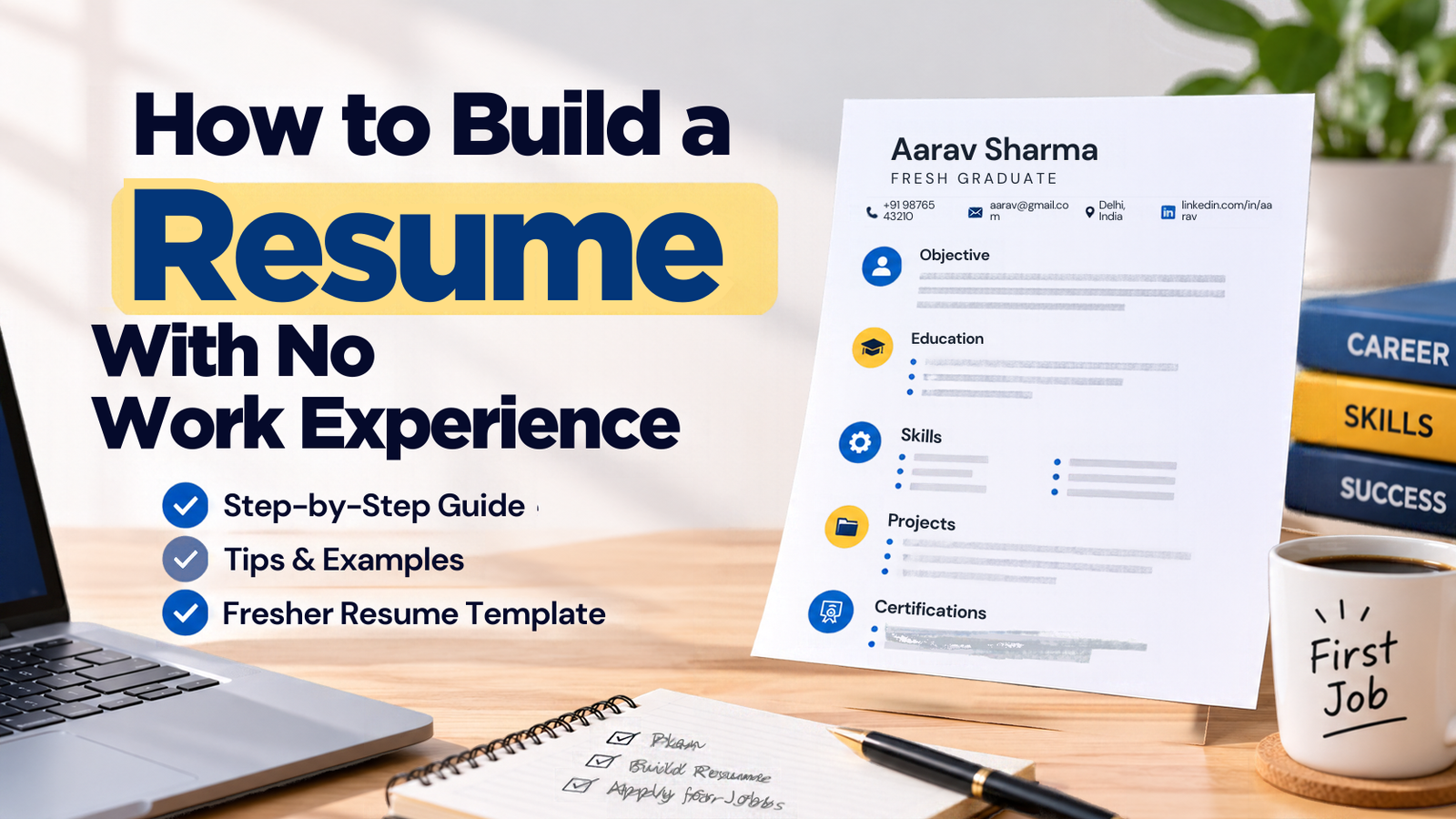
Creating a resume without work experience can feel difficult, especially when you are applying for your first job or internship. You may think you have nothing to show because you have never worked for a company. But your education, academic projects, practical skills, volunteer work, and independent learning can all help demonstrate your abilities.
The purpose of a fresher resume is not to pretend you have professional experience. It is to show an employer what you can do, what you have learned, and why you are suitable for the position.
This guide explains how to build a resume with no work experience, which sections to include, what to write in each section, and how to avoid common mistakes. It also includes a simple resume template you can adapt for your first job.
1. What Should a Resume Include When You Have No Experience?
A fresher resume should focus on education, relevant skills, projects, and achievements instead of a long employment history.
For most entry-level applications, a one-page resume is a practical starting point.
Include these sections in a clear order:
- Contact information
- Resume objective
- Education
- Relevant skills
- Academic or personal projects
- Internships, volunteering, or extracurricular activities, if applicable
- Certifications or achievements, if relevant
You do not need to include every section if you have nothing useful to add. For example, if you have no certificates, leave that section out rather than listing unrelated courses simply to make the page look full.
Your resume should reflect the requirements of the job you are applying for. Harvard’s Guide to Creating a Strong Resume also recommends highlighting your strongest qualifications and tailoring your resume to the position.
2. Start With Clear Contact Information
Place your contact details at the top of your resume so employers can reach you easily.
Include:
- Your full name
- A professional email address
- Your phone number
- Your city and state
- Your LinkedIn profile or portfolio, if relevant
For example:
Rahul Sharma
Delhi, India
Phone: +91-XXXXXXXXXX
Email: rahul.sharma@email.com
Portfolio: yourportfolio.com
Use your real information when preparing the final resume. The example above is only a sample.
You generally do not need to include your full residential address, religion, marital status, or unrelated personal details. Add a photograph only when the employer or application instructions specifically request it.
Before submitting your resume, check that your email address is professional and that the phone number is correct.
3. Write a Resume Objective That Explains Your Goal
When you have little or no work experience, a short resume objective can explain the position you want and the skills you bring.
Keep it specific. Avoid generic statements such as “I am a hardworking and dedicated person looking for a challenging opportunity.”
Instead, identify the role and connect it to your relevant abilities.
Example for a commerce student
“Commerce student seeking an entry-level accounting position. Familiar with basic accounting principles, Excel, and financial record-keeping, with an interest in developing practical experience in accounts and finance.”
Example for a computer science student
“Computer science graduate seeking a junior software development role. Familiar with Python, SQL, and basic web development, with academic projects involving programming and database management.”
Example for a general fresher
“Recent graduate seeking an entry-level operations role, bringing strong organisational skills, spreadsheet knowledge, and an interest in supporting day-to-day business processes.”
Use only the skills you genuinely possess. If you have not used a particular tool or completed a relevant project, do not claim otherwise.
4. Present Your Education Properly
When you have no employment history, education can help employers understand your background.
List your most recent qualification first.
For example:
Bachelor of Commerce (B.Com)
ABC College, Delhi University
Expected graduation: 2027
Relevant subjects: Financial Accounting, Business Economics, Business Law
Class 12 — Commerce
XYZ Senior Secondary School, CBSE
2024 | 78%
Class 10
XYZ Senior Secondary School, CBSE
2022 | 82%
These details are illustrative. Replace them with your actual information.
You do not need to list every subject you studied. Include subjects that relate to the target job, and mention marks or percentages if they strengthen your application or are required by the employer.
If you are a recent graduate, you can usually shorten your school education section as you gain more relevant qualifications and experience.
5. Add Skills That Match the Job
A resume becomes more convincing when its skills are relevant to the vacancy.
Read the job description and identify the abilities the employer requests. Include those that you genuinely have, rather than copying every keyword into your resume.
Technical skills
Depending on your target role, these may include:
- Microsoft Excel
- Google Sheets
- TallyPrime
- Python or Java
- HTML and CSS
- SQL
- Canva or graphic design tools
- Data entry and document management
Transferable skills
These are abilities that can be useful across different types of work:
- Written communication
- Time management
- Problem-solving
- Teamwork
- Organisation
- Research
- Presentation skills
Whenever possible, support a skill with evidence elsewhere in your resume.
For example, instead of merely writing “good communication,” describe a college presentation, student activity, or volunteer task where you used that ability.
Avoid rating yourself as an expert in every skill. Accurate descriptions help employers understand what tasks you can realistically handle.
6. Use Projects to Demonstrate Your Abilities
Projects are one of the most useful ways to strengthen a resume when you have no formal work experience.
They can come from college assignments, personal experiments, online learning, or independent practice. Choose projects that demonstrate skills relevant to your target job.
Example: Resume for an accounting position
Project: Monthly Expense Tracker
- Created a spreadsheet to organise sample income and expenses.
- Used formulas to calculate totals and compare spending categories.
- Prepared a summary report to make the financial information easier to review.
Example: Resume for a web development position
Project: Personal Portfolio Website
- Built a responsive website using HTML and CSS.
- Created separate sections for projects, skills, and contact information.
- Tested the layout on different screen sizes.
Example: Resume for a marketing position
Project: Social Media Content Plan
- Prepared a sample content calendar for a fictional business.
- Created social media graphics using Canva.
- Organised post ideas by topic, format, and intended audience.
These are examples of how to describe projects, not claims about work you have completed. Only include projects you have actually created.
When describing a project, explain what you built or investigated, which tools you used, and what the result was. This gives an employer something concrete to discuss during an interview.
7. Include Internships, Volunteering, and Other Activities
Professional employment is not the only way to demonstrate useful experience.
You may have developed relevant abilities through:
- College clubs or student societies
- Volunteering for an event or organisation
- Organising a college programme
- Tutoring students
- Helping with a family business
- Participating in a legitimate internship
- Maintaining a website or creating a portfolio
For instance, if you helped organise a college event, you might describe your responsibilities for registration, scheduling, communication, or coordination.
If you volunteered for a local organisation, explain the actual tasks you performed.
Use genuine examples and avoid presenting unpaid work, personal projects, or classroom assignments as paid employment. You can create separate sections such as “Projects,” “Volunteer Experience,” or “Leadership and Activities.”
8. Choose a Clean, Professional Resume Format
Your resume should be easy to scan on a screen and readable when printed.
Use these formatting principles:
- Choose a simple font, such as Arial, Calibri, or another clear sans-serif font.
- Keep heading sizes consistent.
- Use short bullet points instead of lengthy paragraphs.
- Maintain consistent spacing and margins.
- Use a straightforward, preferably single-column layout.
- Save and submit the file in the format requested by the employer, usually PDF when no other format is specified.
Avoid excessive colours, decorative graphics, skill-rating bars, and complicated tables that make the content difficult to read.
Some employers use applicant tracking systems (ATS) to process resumes. A simple layout with clear headings helps reduce the risk of important information being read incorrectly. CareerOneStop’s resume formatting guidance discusses the advantages and limitations of different layouts.
You do not need an expensive design tool to create a professional resume. A basic document created in Word or Google Docs is often enough.
9. Common Resume Mistakes to Avoid
A resume can lose its effectiveness when it contains unnecessary information or claims that cannot be supported.
Avoid these common mistakes:
Using the same resume for every job: Adjust your objective, skills, and project descriptions to match each relevant vacancy.
Adding false experience: Never invent internships, job titles, achievements, or technical abilities. You may be asked to explain them during an interview.
Writing long personal statements: Use the space to show relevant information rather than repeating that you are hardworking, honest, or passionate.
Listing irrelevant skills: Focus on skills that help demonstrate your suitability for the target position.
Ignoring spelling and formatting: Check spelling, dates, contact details, and alignment before sending the file.
Including an empty experience section: If you have not worked professionally, leave the section out. Use projects or relevant activities to demonstrate what you can do instead.
10. Simple Resume Template for Freshers
You can copy the following structure into Microsoft Word or Google Docs and replace the placeholders with your actual details.
[YOUR FULL NAME]
[City, State] | [Phone Number] | [Professional Email] | [Portfolio or LinkedIn, if relevant]
RESUME OBJECTIVE
[Write two or three short sentences explaining the position you want, your relevant skills, and the value you can bring.]
EDUCATION
[Degree or Qualification]
[College or School Name] | [Year or Expected Graduation]
[Relevant subjects, marks, or academic details, if useful]
SKILLS
- Technical: [Relevant software, tools, or technical abilities]
- Professional: [Communication, organisation, or other relevant skills]
PROJECTS
[Project Name]
- [Describe what you created or worked on.]
- [Mention the tools or skills you used.]
- [Explain the outcome or what the project demonstrates.]
INTERNSHIPS OR VOLUNTEER EXPERIENCE
[Organisation or Activity] | [Dates]
- [Describe your actual responsibilities.]
- [Mention a relevant achievement or contribution.]
CERTIFICATIONS AND ACHIEVEMENTS
- [Relevant course or certification, issuing organisation, and completion date]
- [Academic award or genuine achievement, if applicable]
Delete any section that does not apply to you. A shorter, relevant resume is better than one filled with unnecessary information.
Frequently Asked Questions
Can I get a job without work experience?
Yes. Some entry-level vacancies and internships are open to candidates who have not worked professionally. Your eligibility will depend on the role, employer, education, and required skills.
Should a fresher resume be one page?
One page is generally a useful target when you have limited experience. Add another page only when you have enough relevant information to justify the additional length.
Should I include hobbies on my resume?
Include hobbies only when they demonstrate something relevant or provide a useful conversation point. For example, maintaining a personal coding project may support a software application more directly than listing general interests.
Can I use AI or a resume builder?
Yes. These tools can help with formatting, organisation, and wording. Review the final resume carefully to ensure every statement is accurate, specific, and consistent with your actual experience. India’s National Career Service also provides job-search support and a resume-building tool.
Conclusion
You do not need a long employment history to prepare a strong fresher resume. Focus on your education, relevant skills, real projects, and any activities that demonstrate your abilities.
Start with a simple format, adapt it to the job you want, and remove anything that does not help your application. Your first resume does not have to show everything you will accomplish in your career. It needs to give an employer a clear and honest reason to consider you for the next step.
Written by: Nishant Verma
Published: October 10, 2026